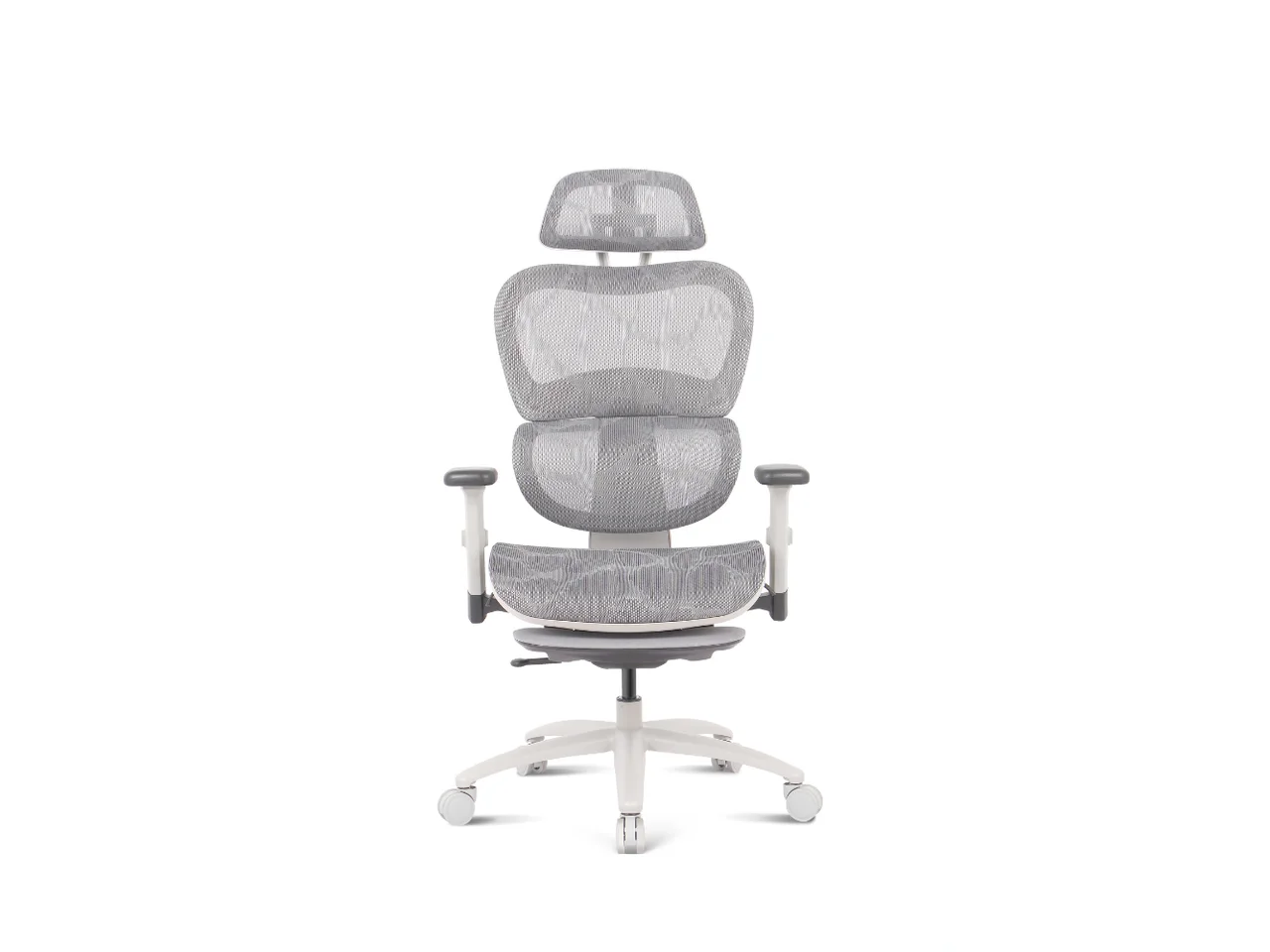
"Mesh or foam — which is better?" We get that question most weeks, and it does not have a clean answer, because better depends on your climate, your price point and how the chair gets used. What we can do is tell you how each one fails, because that is what decides a wholesale program.
How foam ages
Foam comfort is mostly about density, measured in kg/m³, and it is the spec most often hidden in a low quote. A good molded seat foam for a commercial chair sits around 50–65 kg/m³. Below that, the seat feels fine in the showroom and then compresses — you see the dip and the user feels the front edge within a year of daily use. The painful part is that you cannot tell 35 kg/m³ from 55 kg/m³ by sitting on a fresh sample. You can only tell it from the spec sheet and a cut test, which is why we list density on our office-chair quotes rather than writing "high-density" and leaving it vague.
How mesh ages
A good mesh holds tension for a long time — five to ten years of meaningful service is normal, and there are well-known mesh task chairs still in offices after fifteen or twenty. Mesh also runs cooler, which matters more than people think for hot, humid markets where a foam seat traps heat. The failure mode for mesh is different: it is the frame and the edge binding, not the surface, that gives out first, and a cheap mesh stretched on a thin frame sags at the corners.
The trade-off we put on the table
Here is the call we help buyers make. For Middle East, Southeast Asia and southern-US programs, we lean mesh — cooler, lighter to ship, and it does not show the one-year sag that gets your reseller emails. For colder markets and for executive lines where buyers expect a padded seat, foam wins, but only if you hold the density line. The compromise many of our buyers land on is a mesh back with a foam seat: breathable where the body heats up, cushioned where it bears weight. It is not a fence-sit; it is the configuration that generates the fewest complaints.
The cost angle is real too. Mesh chairs are usually lighter, so you can sometimes fit more per 40-foot container before you cube out — which lowers your landed cost per chair. Foam executive chairs are bulkier and cube out faster.
Send us your market and your target retail price and we will recommend a seat construction and quote the foam density in writing. We build to BIFMA/EN test methods and testing can be arranged. Reach us via the contact form or [email protected], or read how we set up a private-label run on our ODM/OEM page.